

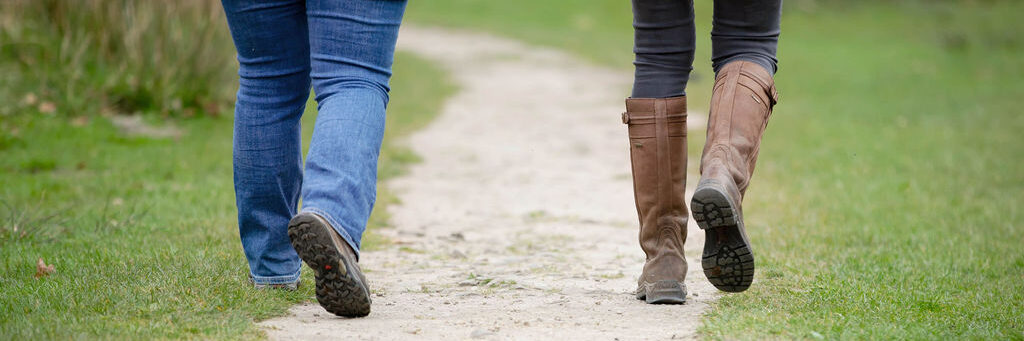
Have you ever gone for a walk when you were stressed, and come back feeling just a little clearer?
Not because anything had changed. But somehow, you had.
I notice this in myself all the time. Some of my best thinking happens when I’m moving. A problem that felt stuck starts to loosen. A feeling I couldn’t name becomes a little clearer. Things shift. It’s one of the reasons I became so passionate about walking therapy — and why I’ve been practising it for years now in and around the beautiful green spaces of Cheshire and Greater Manchester.
But I’m not just going on instinct here. The research backs this up in some really compelling ways.
What happens when we move
When we walk, we’re not just moving our bodies. We’re helping our nervous system regulate. The rhythmic, bilateral nature of walking — left, right, left, right — has a genuinely settling effect on our stress response. It lowers cortisol and slows the heart rate. That creates a kind of gentle physiological calm. And calm makes it easier to access thoughts and feelings we might otherwise keep at arm’s length.
This isn’t just a nice idea. A systematic review published in JMIR Public Health found that walking had a significant positive effect on both depression and anxiety. Its impact was comparable to other evidence-based interventions. A separate review of 17 studies found that nature-based walking specifically improved mood, optimism, and overall mental well-being in adults.
For anyone who has ever felt their thoughts loosen up on a walk, that’s not your imagination. That’s your brain working better.
The power of side by side
Walking side by side also changes the therapeutic dynamic in a way that I think is really significant.
There’s no direct eye contact if you don’t want it. No sitting opposite someone, waiting for you to speak. No clock on the wall and no tissue box in the corner reminding you that you’re supposed to be upset. Just two people, moving forward together.
A lot of my clients find that easier. And I do too.
Research published in Counselling and Psychotherapy Research (2024) found that the movement and outdoor setting gave clients a greater sense of freedom. They felt more able to express themselves. Walking sessions helped them gain a broader perspective, heightened self-awareness, and greater acceptance of life’s challenges. That really does reflect what I see in my practice.
I’ve had clients say things on a walk they’d never said in a room. Sometimes the space, literally, helps.
“This research shows that therapy doesn’t always have to happen in a room. For some people, being outdoors creates the space they need to reflect, heal and move forward.”
— Professor Terry Hanley, University of Manchester (2026)
Nature plays its part
We’re lucky to have some beautiful spots on our doorstep here in Cheshire and Greater Manchester — Lyme Park, the towpaths of Altrincham and Wilmslow, the green corridors through Bramhall and Poynton. (If you’re looking for inspiration, I’ve written about some of my favourite parks to walk in Greater Manchester and Cheshire.) Parks, countryside, water. Being outdoors — even briefly — can reduce stress hormones, lower anxiety, and lift mood.
Research from the University of Manchester, published in 2026, found that connecting with nature during therapy helped people reconnect with hope, accept difficult experiences, and feel more present. And studies consistently show that those who regularly exercise in green spaces have significantly lower rates of poor mental health than those who don’t.
You don’t need a forest. Even a local park counts. Nature becomes a quiet, steady presence alongside us as we talk. And that matters more than we sometimes give it credit for.
Walking therapy and the therapeutic relationship
One thing I’m sometimes asked is whether walking therapy might feel less safe, or less boundaried, than sitting in a room. It’s a fair question.
In my experience, the opposite is often true. A large review of outdoor therapy studies found that both therapists and clients valued walk-and-talk sessions highly. Practical challenges — such as privacy or weather — can be managed effectively with the right preparation. Rather than weakening the therapeutic relationship, the shared experience of being outdoors can actually deepen it.
There’s also something about accessibility. For some people, walking into a therapy room feels like a big step — formal, clinical, exposing. Being outdoors is less so. It’s a more human way to begin.
“Integrating walking into psychotherapy is a novel opportunity to improve emotion regulation, facilitate therapeutic alliance, and integrate therapy skills.”
— Walking Psychotherapy as a Health Promotion Strategy, PMC (2022)
Is it still proper therapy?
Absolutely.
Walking therapy is the same therapeutic work, just in a different setting. Everything I offer in my Wilmslow office, I bring outdoors with me too. I work with the same training, the same ethical framework, the same relational care. The only difference is that we’re moving.
And more often than not, that movement unlocks something.
If you’d like to read more about the research behind walking therapy, the Open University has a really accessible, well-evidenced piece worth a look: Outdoor Therapy: The Benefits of Walking and Talking.
Curious about whether walking therapy might suit you?
I offer walking therapy from a number of lovely locations across Cheshire and Greater Manchester, as well as face-to-face sessions at my Wilmslow office and online.
If you’d like to explore whether this might be right for you, I’d love to have a chat. Get in touch via my contact page. I offer a free 30-minute introductory session — a chance to ask questions and see if we’re a good fit.
Sometimes the best way forward is just to start walking.